Bu dao Changcheng, fei hao Han. “If you don’t go to the Great Wall, you’re not a real man.” This is a popular saying in China, commonly ascribed to Chairman Mao (one source I’ve found said that the line originates in a poem he wrote during the Long March, giving the quote an interesting political-literary context). Interestingly, the character for “man” (Han) also refers to the Chinese themselves, and so it can also be translated as “If you don’t go to the Great Wall, you’re not a good Chinese,” but almost all English translations I’ve seen translate it as “man.” Well, whichever it is, I guess I am now a “real man” or “good Chinese.” The marathon is complete!
I went to the “inspection day” on Thursday, where the race organizers require you to walk the portion of the Great Wall, about 80 miles outside of Beijing, that is the site of the race. It would clearly have been possible to not do this, and to some extent I regretted using my legs in this way just two days before the race, but nonetheless I participated. This time we took a bus up the 3 mile climb to the wall entrance—on race day the climb is the beginning of the run. The elevation profile of the race unfortunately does not seem to be available anywhere online, though they had it on display at the race site. We walked the Great Wall section and then descended steeply back down to the start/finish area—the bulk of the 3800 steps (walked twice in the marathon) are in that part of the course.
I then stayed the rest of Thursday and Friday in a guest house literally at the foot of the Wall, which was actually completely boring, as I wanted to walk as little as possible. I read quite a bit and otherwise spent a lot of time stewing in my own incredibly anxious juices. One race organizer, staying in the hotel where I stayed, informed that that this is considered an “extreme marathon.” Really?
So, the race course, briefly described, basically consists of:
1. a 3 mile steady climb to get onto the Wall (since the Wall is built on top of mountains, you have to get up the mountain first to get onto the Wall, of course raising the question of why they felt they needed a Wall on top of the already-existing mountains)
2. 2 miles on the Wall (lots of up and down, but more down this way) and then back down off it
3. about 16 miles through various villages and countryside, including two other rather long ascent-descent sequences (one of them was probably about 1 1/2 miles up and another 1 1/2 miles down—a bit of a cruel joke to play in the middle of a race like this one)
4. back onto the Wall, this time backwards, so the steps that you descended to get off the Wall are now climbed to get back up onto it (this was probably about 1000+ steps, all going up)
5. 3 miles, this time nicely downhill, to get to the finish line
The time limit in the race is eight hours—they give you six hours to get onto the Great Wall for the second time. I was hoping to do the first 5 miles in under two hours—and I did it in less than 90 minutes, so that was good. Legs were shaky after first getting off the wall but then I got my rhythm and felt good.
The middle part of the course was through the countryside. I didn’t have a camera with me and really regretted not bringing one—the countryside was lovely as were all of the Chinese spectators. There were bunches of children along the course, some handing out little flowers that they had picked from along the road, and many wanting to give high fives. One village had organized a cheer squad, with a woman leading a group of children in rhythmically crying “jia you!” which literally means “step on the gas!” I had a conversation with a boy on a bicycle who wanted to see my watch and who declared it “piaoliang” (pretty), which it really is not.
The temperature was steadily rising through the day although I don’t think it really hit 90 degrees as this article claims:
Spaniard Beats Great Wall Marathon Record
There were lots of points where they were handing out bottled water, although a few of them were already out of water when I got there. I had a drop bag at the 16 mile point with a bottle of Pocari Sweat (my energy drink of choice here in China, for the name if nothing else) and a can of coffee (caffeine can never be a bad thing at times like this). But I basically felt good on this portion, intentionally holding back in my pacing.
I hit the Great Wall for the second time at exactly five hours, which I was pleased about. I was deliberately going slowly in the middle section, walking most of the uphills so as to save my legs for the last climb. And a climb it was. It was a long, steep ascent up many, many stone stairs and a goat path to get back onto the Wall itself. It was pretty much like watching a giant car wreck—many people were groaning, stopping, massaging their calves, and even sitting down. I was determined not to stop and definitely not to sit (seems like once you sit you are planted in that spot permanently, never to move again) so I just tried to very slowly but steadily climb. I was checking splits on my watch every 5 km (about 3 miles) and the 5 km with that section of the race took me about 1 hour and 20 minutes—as opposed to 36 minutes for my fastest 5km during the race and under 30 minutes for me to race 5 km! It was good to actually get on the Wall since that featured at least some descents which allowed for some variety of muscles being used.
This time the Wall, counting the climb up to it, took me an hour, which I was actually quite happy with (one hour for 1.5 miles…). I was completely joyful when I finally got off the Wall and started the nice descent back down the road I had started on about 6 hours earlier. I was able to run most of this fairly easily and was equally joyful when I crossed the finish line in about 6 hours, 38 minutes. The conventional wisdom seems to be that this course takes about 1 1/2 times longer than the standard marathon course, so I am happy with this time.
Today I am sunburned, somewhat sore, and very tired, but I’m off for lunch with an Allegheny student and her mother (from China) and then to the race banquet tonight. I’ll post a few more pictures in the next day or so.
Sunday, May 20, 2007

Sunday, May 13, 2007
tapering
It is now race minus 6 days. I am feeling a variety of emotions—nerves, excitement, anticipation of the inevitable post-race letdown. According to weather.com, the currently predicted high for race day is 92 degrees. I think it probably goes without saying (but I’ll say it anyway) that that is a Very Bad Thing. I’m guessing that anything resembling shade will be a precious commodity along the race course, given the overall lack of trees here and the exposure on the Great Wall section in particular.
I have actually never run a marathon alone, so this will be a very different experience for me in a number of ways. All of my races except one have been with Jim, and the exception I ran with my friend Bubbles (a.k.a. Kathy). I’ve also never trained so much on my own, which has had its difficult moments but has also been really good for my psyche. I feel more like I have made “friends with myself” in ways that I never did before.
In my running, I’ve been tapering this week, which is good because work has been busy. First I made a short trip to a town in rural Hebei province to meet a female village head, which was interesting. China has elections at the village level that are genuinely competitive, but villages also have a Communist Party structure that provides a competing source of authority, and so although this woman was elected by a landslide by her fellow villagers, she often lacks the clout to actually govern, and was in tears describing her frustrations.
I also attended a conference of six women’s NGOs, which was a good reminder of how, anywhere you go in the world, some things are basically the same. This meeting was like any other academic conference I’ve attended where people are given 10 minutes to summarize their report/paper and are completely incapable of being anything resembling succinct. This leads to an escalating series of maneuvers by the panel moderator to get them to shut up—first finger waving (“2 minutes to go!”) then verbal intervention (“time’s up!”), more verbal intervention (“TIME’S UP!!!!”) and finally, application of duct tape. People at this conference also adopted the strategy of speaking as fast as they possibly could and of going through their Powerpoint slides at a brisk pace, and since it was all in Chinese, this was extra-challenging for me.
On a somewhat different note, there is an excellent article about Beijing, describing many of the things I also love about the city, in today’s Washington Post:
Beijing’s Moment
One correction from a Zhongguotong (“Old China Hand”—something people here sometimes call me). The photo at the top of the article is not Mao’s Mausoleum, but Tiananmen Gate (“the Gate of Heavenly Peace”), which is the entrance to the Forbidden City.
I don’t know if I will blog again between now and when I leave for the race (4:45 a.m. on Thursday morning, bleh). I will be spending the two nights prior to the race at the Wall. If you think of it at 7:30 p.m. Friday night eastern standard time, please send some good vibes my way, as the race starts here Saturday at 7:30 a.m. Many thanks to all who have been reading this and offering support!
I have actually never run a marathon alone, so this will be a very different experience for me in a number of ways. All of my races except one have been with Jim, and the exception I ran with my friend Bubbles (a.k.a. Kathy). I’ve also never trained so much on my own, which has had its difficult moments but has also been really good for my psyche. I feel more like I have made “friends with myself” in ways that I never did before.
In my running, I’ve been tapering this week, which is good because work has been busy. First I made a short trip to a town in rural Hebei province to meet a female village head, which was interesting. China has elections at the village level that are genuinely competitive, but villages also have a Communist Party structure that provides a competing source of authority, and so although this woman was elected by a landslide by her fellow villagers, she often lacks the clout to actually govern, and was in tears describing her frustrations.
I also attended a conference of six women’s NGOs, which was a good reminder of how, anywhere you go in the world, some things are basically the same. This meeting was like any other academic conference I’ve attended where people are given 10 minutes to summarize their report/paper and are completely incapable of being anything resembling succinct. This leads to an escalating series of maneuvers by the panel moderator to get them to shut up—first finger waving (“2 minutes to go!”) then verbal intervention (“time’s up!”), more verbal intervention (“TIME’S UP!!!!”) and finally, application of duct tape. People at this conference also adopted the strategy of speaking as fast as they possibly could and of going through their Powerpoint slides at a brisk pace, and since it was all in Chinese, this was extra-challenging for me.
On a somewhat different note, there is an excellent article about Beijing, describing many of the things I also love about the city, in today’s Washington Post:
Beijing’s Moment
One correction from a Zhongguotong (“Old China Hand”—something people here sometimes call me). The photo at the top of the article is not Mao’s Mausoleum, but Tiananmen Gate (“the Gate of Heavenly Peace”), which is the entrance to the Forbidden City.
I don’t know if I will blog again between now and when I leave for the race (4:45 a.m. on Thursday morning, bleh). I will be spending the two nights prior to the race at the Wall. If you think of it at 7:30 p.m. Friday night eastern standard time, please send some good vibes my way, as the race starts here Saturday at 7:30 a.m. Many thanks to all who have been reading this and offering support!
Sunday, May 6, 2007
patience
It is said (by someone) that the advantage of trail running is that you are not stuck so much in your own thoughts as you are when you are pounding the concrete, since you must remain mentally alert to stones, tree roots, etc. and that this gives your mind something to play with as you run. Well, trail running is not really an option here in Beijing, given (as I’ve noted previously) that the entire city is being paved over. However, there is really no excuse for mental boredom here, either—as I’ve also noted before, running here provides its own set of obstacles. I particularly pondered this today as I ran my 10 miles in the Purple Bamboo Park. It is supposed to hit 90 degrees here today, so I headed out early (-ish, at about 9:30 a.m.) and the park was already jam packed full of people, probably also trying to beat the heat. It truly is a test of one’s patience to run or even sometimes just to walk here. It is a constant game of dodging people to avoid causing upset or international incident. For instance, there is the “little emperor” syndrome—six adults (two sets of grandparents and one set of parents) walking their only child/grandchild, all six abreast on the sidewalk, the child pondering this phenomenon Buddha-like in his or her stroller, still blissfully unaware of the pressures to be heaped upon him or her as the only realization of the expectations of six grown-ups. Or there are the crowds of people gathered around pigeons or ducks, feeding possibly the only wild animals some of them are likely to see in their lives.
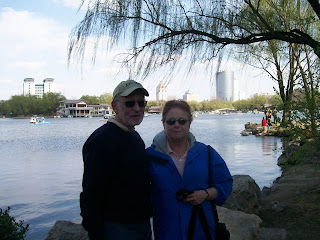
My parents in Purple Bamboo Park:
I’m sure this has been written already to death by Max Weber and other observers of the religion-culture-society link, but I’m not sure it is accidental that Buddhism, with its emphases on patience and compassion, arose in crowded Asia (yes, I’m aware that it is more crowded now than when the Buddha was around). I know that being here is all too often a test of my own patience, as well as my social-science derived convictions of the structural causes of much of the human condition. (By that I just mean, greatly oversimplifying, that if one is rich, or poor, or gets into Harvard, or is a poor peasant with “low quality,” is not just determined by one’s own good efforts but is also a product of the pre-determined conditions of one’s birth and existence.) For instance, when I was in Beidaihe, the seaside resort town, for the May Day holiday this past week I was often greeted by “Hellloooo,” said as if I was on exhibit in some zoo of laowais. After awhile, this drove me quite round the bend, but I also tried to remember that many people here never see a foreigner in the flesh. (Beidaihe is another story, entirely. The high leaders spend much of the summer there and so a very large chunk of beach is closed off for their private use, complete with lush-looking bathhouses.)
In any event, such contemplation of the need for patience also makes we rather aware of the manifold contradictions in the Chinese zeitgeist (is that some sort of oxymoron?) these days. On the one hand, China has historically been, and still thinks of itself as, the “Middle Kingdom,” the center of the civilized universe. On the other hand, everywhere you go people are being told to be more “civilized” (often for justifiable reasons). Today in the park I noticed various posters promoting “Pledging civilized behavior for Chinese citizens traveling domestically [or abroad],” such as this one:
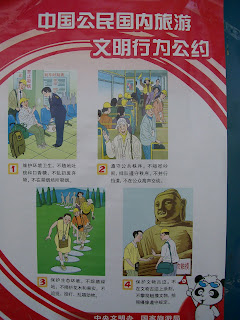
Who wouldn’t be confused about their national identity with these messages?
My parents in Purple Bamboo Park:

I’m sure this has been written already to death by Max Weber and other observers of the religion-culture-society link, but I’m not sure it is accidental that Buddhism, with its emphases on patience and compassion, arose in crowded Asia (yes, I’m aware that it is more crowded now than when the Buddha was around). I know that being here is all too often a test of my own patience, as well as my social-science derived convictions of the structural causes of much of the human condition. (By that I just mean, greatly oversimplifying, that if one is rich, or poor, or gets into Harvard, or is a poor peasant with “low quality,” is not just determined by one’s own good efforts but is also a product of the pre-determined conditions of one’s birth and existence.) For instance, when I was in Beidaihe, the seaside resort town, for the May Day holiday this past week I was often greeted by “Hellloooo,” said as if I was on exhibit in some zoo of laowais. After awhile, this drove me quite round the bend, but I also tried to remember that many people here never see a foreigner in the flesh. (Beidaihe is another story, entirely. The high leaders spend much of the summer there and so a very large chunk of beach is closed off for their private use, complete with lush-looking bathhouses.)
In any event, such contemplation of the need for patience also makes we rather aware of the manifold contradictions in the Chinese zeitgeist (is that some sort of oxymoron?) these days. On the one hand, China has historically been, and still thinks of itself as, the “Middle Kingdom,” the center of the civilized universe. On the other hand, everywhere you go people are being told to be more “civilized” (often for justifiable reasons). Today in the park I noticed various posters promoting “Pledging civilized behavior for Chinese citizens traveling domestically [or abroad],” such as this one:

Who wouldn’t be confused about their national identity with these messages?
Monday, April 30, 2007
might makes right
Today was my last long run before the race—22 miles. It went fairly well, especially given that I’ve just been reading about air quality (or lack thereof) in Beijing and have received new statistics to actually back up my general impression that the air here is, well, completely gross (I just looked up “gross” in the MS Word thesaurus—one synonym is “sickening” which of course relates to the spitting, the cold I had that refused to quit, etc.—the air literally makes people sick).
According to the Chinese State Environmental Protection Agency website, the API in Beijing today is 151—giving it a 3B “grade” so far as air quality goes. This is by far the worst throughout China—only a few other cities even get above 100, and Beijing is the only city to get a grade of 3B (the others over 100 get 3A). What does this mean? Well, among other things it means that 151 is at the very edge of being “unhealthy” (as opposed to “unhealthy for sensitive groups”, which is the range of API between 100 and 150). At 151, the air starts being unhealthy for everyone, probably including runners.
The weather report on one Chinese website always lists air quality and usually says it is “jiaocha” which means “relatively bad.” I think this is probably a politically correct understatement. One major reason for all of this pollution is the number of cars on the road in Beijing—currently, there are over 1000 new private cars joining Beijing’s already gridlocked traffic every day. One in five cars in China is a Beijing car, at least according to a taxi driver I recently discussed this with (about one in 100 people in China resides in Beijing, for some comparison). Interestingly the website where I check the weather also features a “car wash index” which tells you whether it is an “appropriate” day to wash your car (apparently people can’t make this decision on their own) and also a report regarding whether it is good day to turn on their air conditioning (ditto on the decision-making).
Relating to cars, today on my run, which was in the Yuyuantan Park, I spent some time while running on the otherwise pleasant pedestrian pathway being closely followed by a park vehicle, which passed me at the first available opportunity. I was determined not to stop to let it pass—here, while “human rights” (renquan) are often rather lacking, it would seem that “car rights” (chequan—not really a word, just one I’m making up) are quite prevalent. There is frequent discussion of how China is a renzhi society—“rule by men”—rather than fazhi—“rule by law” and how this needs to change. However, the conception of “rights” here is itself problematic—the word for “rights,” quanli, sounds exactly like the word for “power,” also quanli, and they have the same root character of quan (the li is a different character but is pronounced exactly the same). So, in a sense, in China “might” literally does make “right.” This is utterly evident when it comes to the hierarchy of people in relation to cars, in which cars far outrank people, the implication of course being that the person driving the car far outranks the one walking down the street. Most people here buy cars not for convenience (taxis are incredibly cheap—about $5 for a ride across town, about $13 for a taxi to the airport from the opposite side of town—and cars are expensive, with foreign brands marked up a great deal over their home-country prices) but for “face”—to show that they have money, status, etc. So, for instance, right turn on red here does not entail waiting for there to be no traffic before going, but completely ignoring the red light as well as the pedestrians trying to cross the street and just barreling through.
The run was good, however. The highlight: a group of about 40 middle-aged folks learning Latin dancing, swinging their hips in a rather un-Chinese fashion.
According to the Chinese State Environmental Protection Agency website, the API in Beijing today is 151—giving it a 3B “grade” so far as air quality goes. This is by far the worst throughout China—only a few other cities even get above 100, and Beijing is the only city to get a grade of 3B (the others over 100 get 3A). What does this mean? Well, among other things it means that 151 is at the very edge of being “unhealthy” (as opposed to “unhealthy for sensitive groups”, which is the range of API between 100 and 150). At 151, the air starts being unhealthy for everyone, probably including runners.
The weather report on one Chinese website always lists air quality and usually says it is “jiaocha” which means “relatively bad.” I think this is probably a politically correct understatement. One major reason for all of this pollution is the number of cars on the road in Beijing—currently, there are over 1000 new private cars joining Beijing’s already gridlocked traffic every day. One in five cars in China is a Beijing car, at least according to a taxi driver I recently discussed this with (about one in 100 people in China resides in Beijing, for some comparison). Interestingly the website where I check the weather also features a “car wash index” which tells you whether it is an “appropriate” day to wash your car (apparently people can’t make this decision on their own) and also a report regarding whether it is good day to turn on their air conditioning (ditto on the decision-making).
Relating to cars, today on my run, which was in the Yuyuantan Park, I spent some time while running on the otherwise pleasant pedestrian pathway being closely followed by a park vehicle, which passed me at the first available opportunity. I was determined not to stop to let it pass—here, while “human rights” (renquan) are often rather lacking, it would seem that “car rights” (chequan—not really a word, just one I’m making up) are quite prevalent. There is frequent discussion of how China is a renzhi society—“rule by men”—rather than fazhi—“rule by law” and how this needs to change. However, the conception of “rights” here is itself problematic—the word for “rights,” quanli, sounds exactly like the word for “power,” also quanli, and they have the same root character of quan (the li is a different character but is pronounced exactly the same). So, in a sense, in China “might” literally does make “right.” This is utterly evident when it comes to the hierarchy of people in relation to cars, in which cars far outrank people, the implication of course being that the person driving the car far outranks the one walking down the street. Most people here buy cars not for convenience (taxis are incredibly cheap—about $5 for a ride across town, about $13 for a taxi to the airport from the opposite side of town—and cars are expensive, with foreign brands marked up a great deal over their home-country prices) but for “face”—to show that they have money, status, etc. So, for instance, right turn on red here does not entail waiting for there to be no traffic before going, but completely ignoring the red light as well as the pedestrians trying to cross the street and just barreling through.
The run was good, however. The highlight: a group of about 40 middle-aged folks learning Latin dancing, swinging their hips in a rather un-Chinese fashion.
Friday, April 27, 2007
harder to breathe
A short post—I just did my next-to-last steps workout. 10 repeats for a total of 6080 steps. 3040 ups and 3040 downs. Did it in just under an hour.
On the soundtrack: Aerosmith’s “Dream On” and Maroon 5’s “Harder to Breathe” (sample lyric: “Is there anyone out there? Cause it’s getting harder and harder to breathe.”)
On the soundtrack: Aerosmith’s “Dream On” and Maroon 5’s “Harder to Breathe” (sample lyric: “Is there anyone out there? Cause it’s getting harder and harder to breathe.”)
Tuesday, April 24, 2007
bitter
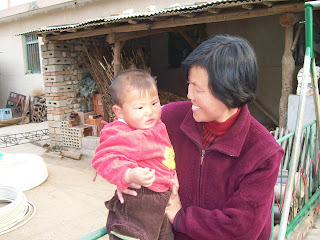
I’ve returned from my trip to rural Hebei Province, where I was primarily visiting a project that establishes small groups to help prevent women’s suicides—rural Chinese women have the highest rate of suicide of any group in the world. I think the highlight was meeting this woman, Li Guimin, who was simultaneously tragic and inspiring, which sums up a lot of lives here, really. The Chinese have a saying, to chi ku, which means to “eat bitterness.” The “bitter” here has much the same meaning as when it is used in American slang (as in a college student saying “I got a C- on my midterm” and his friend replying “Bitter!”) but without the sarcasm. Many people here say that the Chinese are good at chi ku, and there is probably some truth to this. Li Guimin is a 49 year-old woman who is now raising her year-and-a-half old grandson because his mother died mysteriously in her sleep one night and his father, Li Guimin’s son, is working out of the village as a migrant worker, one of millions here. At the same time, however, Li Guimin is a smart and savvy woman who is the head of her village’s suicide prevention groups. There is another saying in Chinese, “nanzhuwai, nuzhunei” which basically means “Men are responsible for outside affairs and women are responsible for inside affairs.” Li noted that now “nuzhuwai” but that “nanbuzhunei.” In other words, women are now also responsible for outside affairs, but men have not taken their share of the “inside” responsibilities. This cracked me up, since this seems to be a problem faced by feminism around the world. (I refer you to my favorite piece of feminist writing, from around 1970, titled “The Politics of Housework.”)
Here is Li and her grandson:
I also just spent two days at a training to promote women’s political participation at a school run by Rural Women outside of Beijing. “Training” is a mania in the NGO sector here these days—much of the time, so far as I can tell, it consists of people sitting around for three hours at a stretch listening to speeches. They seem to have a patience here for this sort of thing that we lack. One hypothesis I have for this relates to the years of communism here—when you have to stand in long lines just to buy a pair of socks, what does it matter that you might have to sit for hours listening to the leaders rattle on (Fidel Castro is apparently supremely talented at this)? While of course in capitalism, time, along with just about everything else, is money. This hypothesis is belied by the fact, however, that queue-jumping is one of the “four pests” they are seeking to eradicate on the road to the Olympics, and no one here really seems to be content to stand in lines at all.
One purpose of all this training is ostensibly to “raise the quality” of those attending. One reason frequently provided for why China is poor (in the county town where I stayed while in the countryside, a monthly income of about $200 is considered quite good) is that its people, and especially its peasants, and even more so its peasant women, have “low quality (suzhi di). Rural Women, the organization, does critique this line of thinking, and I was asked at the training yesterday to give a bit of a talk about how westerners/Americans view this subject. I basically stated that “low quality” is just an excuse the government uses to justify increasing gaps between the rich and poor here (along with the mass of people living on $200 a month, or less), whereas really some of the problem lies in governmental policy. Another American present, representing one of the training’s sponsors, later told Xie Lihua that I had “balls” to say that in front of a room of Chinese people.
Speaking of increasing gaps between rich and poor: new developments of the “villas” increasingly popular among China’s nouveau riche that I passed on the way to the school included “MacAllen Estates,” “Napa Valley,” “Chateau Lafitte Beijing,” and “Vancouver Forest” (where trees are actually quite sparse).
Here is Li and her grandson:

I also just spent two days at a training to promote women’s political participation at a school run by Rural Women outside of Beijing. “Training” is a mania in the NGO sector here these days—much of the time, so far as I can tell, it consists of people sitting around for three hours at a stretch listening to speeches. They seem to have a patience here for this sort of thing that we lack. One hypothesis I have for this relates to the years of communism here—when you have to stand in long lines just to buy a pair of socks, what does it matter that you might have to sit for hours listening to the leaders rattle on (Fidel Castro is apparently supremely talented at this)? While of course in capitalism, time, along with just about everything else, is money. This hypothesis is belied by the fact, however, that queue-jumping is one of the “four pests” they are seeking to eradicate on the road to the Olympics, and no one here really seems to be content to stand in lines at all.
One purpose of all this training is ostensibly to “raise the quality” of those attending. One reason frequently provided for why China is poor (in the county town where I stayed while in the countryside, a monthly income of about $200 is considered quite good) is that its people, and especially its peasants, and even more so its peasant women, have “low quality (suzhi di). Rural Women, the organization, does critique this line of thinking, and I was asked at the training yesterday to give a bit of a talk about how westerners/Americans view this subject. I basically stated that “low quality” is just an excuse the government uses to justify increasing gaps between the rich and poor here (along with the mass of people living on $200 a month, or less), whereas really some of the problem lies in governmental policy. Another American present, representing one of the training’s sponsors, later told Xie Lihua that I had “balls” to say that in front of a room of Chinese people.
Speaking of increasing gaps between rich and poor: new developments of the “villas” increasingly popular among China’s nouveau riche that I passed on the way to the school included “MacAllen Estates,” “Napa Valley,” “Chateau Lafitte Beijing,” and “Vancouver Forest” (where trees are actually quite sparse).
Saturday, April 14, 2007
fate
I realized today that I have been remiss in this blog’s Chinese lessons, so today you’ll get a few words. Our first word is mingyun which means “fate.” The ming in mingyun is also in geming, which means “revolution.” Geming means, literally, to “dismiss fate.” Isn’t that nifty? Doesn’t that just make you want to run out and sign up for a Chinese class?
I’ve been thinking about fate today mostly because of the idea of being “ill-fated,” which my training run today definitely was. I had 20 miles on the schedule for today, made especially difficult because I just did my 18 miler 9 days ago and I usually like to have two weeks between really long runs. I decided to go out to the Yuyuantan Park and try to run 7 laps. The weather today in Beijing is sunny, in the 60s, and somewhat windy. Not shachenbao level windy, but windy. Shachenbao is another new word—it refers to the rather nasty sandstorms that occasionally afflict Beijing in the springtime (someone told me that they are pretty much like the Dust Bowl was in the Great Depression). Even when there is not a shachenbao going on Beijing is rather on the dusty side and so there was a fair amount of junk blowing around. I made it to Yuyuantan Park only to discover that they are having a “Cherry Blossom Festival.” The Chinese are actually not terrifically fond of the Japanese, but apparently that is not enough to stop them from celebrating cherry blossoms. OK, I thought, I’ll go to the track at the university. That, however, was also not meant to be—it was closed for some university visitation day, though there were loads of people around campus and absolutely nothing happening on the track.
So I headed for the King Gym. On the way there I saw two women involved in a fight—I mean literally punching and kicking each other. Such violence is not an entirely uncommon sight here, and rather puts to rest the latest government slogan that China is constructing a hexie shehui or “harmonious society.”
End result: a total of 15 miles, 5 short of my goal but my psyche could only face so long on the treadmill. In two weeks I'll go for 22 miles, my last really long run of the training program. In a certain way, the runs are a relief--at least it is a respite from speaking Chinese. Except for today--while in the King Gym one of the employees asked me whether Bob Dylan is really famous in the United States and if people have problems with the fact that he uses/used drugs (try saying "artistic temperament" in Chinese while also running on a treadmill). Then another employee wanted me to hold down the shop while she went upstairs to buy some candy (appropriate lunch fare for a gym employee, really).
I’ve been thinking about fate today mostly because of the idea of being “ill-fated,” which my training run today definitely was. I had 20 miles on the schedule for today, made especially difficult because I just did my 18 miler 9 days ago and I usually like to have two weeks between really long runs. I decided to go out to the Yuyuantan Park and try to run 7 laps. The weather today in Beijing is sunny, in the 60s, and somewhat windy. Not shachenbao level windy, but windy. Shachenbao is another new word—it refers to the rather nasty sandstorms that occasionally afflict Beijing in the springtime (someone told me that they are pretty much like the Dust Bowl was in the Great Depression). Even when there is not a shachenbao going on Beijing is rather on the dusty side and so there was a fair amount of junk blowing around. I made it to Yuyuantan Park only to discover that they are having a “Cherry Blossom Festival.” The Chinese are actually not terrifically fond of the Japanese, but apparently that is not enough to stop them from celebrating cherry blossoms. OK, I thought, I’ll go to the track at the university. That, however, was also not meant to be—it was closed for some university visitation day, though there were loads of people around campus and absolutely nothing happening on the track.
So I headed for the King Gym. On the way there I saw two women involved in a fight—I mean literally punching and kicking each other. Such violence is not an entirely uncommon sight here, and rather puts to rest the latest government slogan that China is constructing a hexie shehui or “harmonious society.”
End result: a total of 15 miles, 5 short of my goal but my psyche could only face so long on the treadmill. In two weeks I'll go for 22 miles, my last really long run of the training program. In a certain way, the runs are a relief--at least it is a respite from speaking Chinese. Except for today--while in the King Gym one of the employees asked me whether Bob Dylan is really famous in the United States and if people have problems with the fact that he uses/used drugs (try saying "artistic temperament" in Chinese while also running on a treadmill). Then another employee wanted me to hold down the shop while she went upstairs to buy some candy (appropriate lunch fare for a gym employee, really).
Thursday, April 12, 2007
steps
It is only about five weeks until my race, a fact that fills me with some trepidation! I have been training steadily at times and less so at others. Just to give you an idea of what I am preparing for, here is a picture of the Great Wall:

And here is a picture from last year’s race:
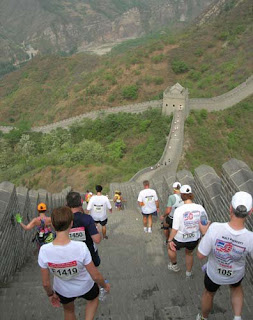
Apparently it is just an urban legend that the Great Wall is the only man-made structure that can be seen from the moon by the naked eye. Nonetheless, it is a rather imposing and impressive structure. The race begins with a 5 ½ mile stretch on the Great Wall itself followed by about 15 miles on roads, and then another 5 ½ miles on the Great Wall. Each Great Wall section features some 3700 steps (both up and down) that are uneven and probably somewhat treacherous (hence the various disclaimers on all the marathon paperwork noting that participants better have their own health insurance and that the race does not cover transport to local hospitals).
Luckily I live on the 11th floor of the building where I’m staying so I’ve been climbing steps, though lately I’ve gotten rather lazy and use the elevator a bit more than when I first arrived here. There are a total of 14 floors in the building, numbered 1-12 (as you’d expect) and then, interestingly, 15 and 16. Of course, 13 is unlucky in the west, and 14 is not terribly lucky here (the word for “four” sounds like the word for “death” in Chinese so, among other things, no one wants mobile phone numbers with 4 in them—even I avoided it when I purchased my number). But there is a 4th floor in the building, just no 14. Sometimes there are strange counting patterns here—for instance, the Beijing subway currently has three lines, numbers 1 and 2 (again, as you’d expect) and number 13 (not so expected).
I’ve started doing step workouts once a week—one time up from bottom to top is 304 steps. Yesterday I did 8 repeats for a total of over 4800 steps (I’m counting the ups and the downs)—it took about 45 minutes. Perhaps this won’t help entirely with the marathon, but it can’t hurt. My plan is to work up to 10 in two weeks (next week I’ll be in the countryside, which will no doubt provide fodder for new running adventures) and then the following week to do 5 repeats, go outside and run a few miles, and then return to do 5 more. Let’s call that a “micro” simulation of the Great Wall Marathon itself.

And here is a picture from last year’s race:

Apparently it is just an urban legend that the Great Wall is the only man-made structure that can be seen from the moon by the naked eye. Nonetheless, it is a rather imposing and impressive structure. The race begins with a 5 ½ mile stretch on the Great Wall itself followed by about 15 miles on roads, and then another 5 ½ miles on the Great Wall. Each Great Wall section features some 3700 steps (both up and down) that are uneven and probably somewhat treacherous (hence the various disclaimers on all the marathon paperwork noting that participants better have their own health insurance and that the race does not cover transport to local hospitals).
Luckily I live on the 11th floor of the building where I’m staying so I’ve been climbing steps, though lately I’ve gotten rather lazy and use the elevator a bit more than when I first arrived here. There are a total of 14 floors in the building, numbered 1-12 (as you’d expect) and then, interestingly, 15 and 16. Of course, 13 is unlucky in the west, and 14 is not terribly lucky here (the word for “four” sounds like the word for “death” in Chinese so, among other things, no one wants mobile phone numbers with 4 in them—even I avoided it when I purchased my number). But there is a 4th floor in the building, just no 14. Sometimes there are strange counting patterns here—for instance, the Beijing subway currently has three lines, numbers 1 and 2 (again, as you’d expect) and number 13 (not so expected).
I’ve started doing step workouts once a week—one time up from bottom to top is 304 steps. Yesterday I did 8 repeats for a total of over 4800 steps (I’m counting the ups and the downs)—it took about 45 minutes. Perhaps this won’t help entirely with the marathon, but it can’t hurt. My plan is to work up to 10 in two weeks (next week I’ll be in the countryside, which will no doubt provide fodder for new running adventures) and then the following week to do 5 repeats, go outside and run a few miles, and then return to do 5 more. Let’s call that a “micro” simulation of the Great Wall Marathon itself.
Thursday, April 5, 2007
horses and jaguars
I ran 18 miles today. It was supposed to be over the last weekend, but I have the third cold of my stay here. Yes, I’d guess that some of you are thinking “how can she run a marathon when she can’t even avoid the Specter of the Common Cold?” Well, that is difficult here. I’d guess that one reason I’ve been getting colds is related to the newly-announced “four pests” that the government is going to try to eradicate before China makes its big global debut in next summer’s Olympics. The four pests are queue-jumping (ha!—good luck with that one), cursing (ditto), smoking (ditto again), and spitting (more dittos). Apparently there have been official “stand in line rather than push in front of others” days, as well as a “smile” campaign and courses to teach shop clerks and taxi drivers how to be more polite. Anyway, the constant spitting makes for a vicious circle, people spit because they have colds, then this just gives other people colds, etc., etc., ad nauseum (or perhaps that should be ad sputum?).
Chinese friends have been plying me with traditional Chinese medicine and I’ve desperately tried it. The short verdict: tastes not so good but it seems to help. Feeling somewhat better today, I decided to seek more adventure, as well as to give myself less of an escape route, by running out toward the suburbs and back along a canal that starts about 1 ½ miles from where I’m staying. On the map it looked promisingly continuous, and I had fond fantasies of getting to some pristine areas as I moved out of the city. Why do I never learn that what looks blank on a map is of course never actually blank in reality, especially in China? Jim and I once departed Beijing and traveled 48 hours by train (it was supposed to be 36, but met delays along the way), 12 hours by long-distance bus, and then a few hours on horseback till we found anything resembling a pristine landscape in China.
Nonetheless, the run was an adventure. The canal was somewhat fetid, to put it politely, when it had water in it, and actually much of it was dry and being worked on for some purpose. I did actually get out of the city, but not before passing an area populated mostly by garbage dumps and military facilities. When I did get to a more pristine area, I was suddenly worried about the isolation, although there were always a few people around, mostly on bicycles. I had brought some money in my pocket in case I desperately needed to bail and get a taxi home. I’m sure this sounds completely contradictory—searching for pristine landscapes and still expecting to find taxis once there, but I actually did see a few taxis along the way.
There were lots of interesting sights. My favorite was actually two, but within 30 seconds of each other, so it counts as one. First was the rather straggly horse and cart that passed me on the other side of the canal. I briefly tried to keep up with the horse, challenging myself to run faster. The horse won, but not by much.
Second was a new-looking Jaguar with Sichuan license plates. This right after the horse and cart pretty much sums up how bizarre things are here these days. Coming from Sichuan by car (which is actually where Jim and I went on the train, bus, and horse in search of pristineness) would just a few years previously have been unimaginable. It would have taken forever and a day, but now they are building new highways at an amazing pace, and road trips are becoming more common here. You haven’t lived till you’ve experienced a Chinese rest stop, believe me.
I also saw a married couple riding matching three-wheeled bicycles with carts on the back with packages of Styrofoam piled 15 feet high. I said hello and they smiled and said hello back, and the man said “this isn’t a very good place to run.” To which I replied, “there isn’t anywhere good to run!” A couple guys drove by in a car and stopped ahead of me. I ran by them and then they caught up to me again with an open window, and one of them asked “Can I help you?” (in English, no less). It was kind of cute, but also worrying since at that point I’d only run 7 miles and thought I looked strong. Perhaps they just thought I’d taken a wrong turn, which was a look I received a lot. Kind of like I was out running along the Central Park Reservoir or someplace where lots of runners actually go and somehow was magically transported to Beijing, where I not only saw no other runners, but not even any other foreigners.
I passed a few small parks with the usual complement of people ballroom dancing and singing in groups, probably Cultural Revolution songs. That seems to be the vogue these days among a certain set of middle-aged folks—going hiking or to the park and singing Cultural Revolution songs along the way. I’m not sure if it is done ironically (I doubt it) or nostalgically (I can’t imagine being nostalgic for the Cultural Revolution—it would be like being nostalgic for the Great Depression, or the Civil War). Perhaps it is just because these are the songs that reside in the collective memory of this generation?
Chinese friends have been plying me with traditional Chinese medicine and I’ve desperately tried it. The short verdict: tastes not so good but it seems to help. Feeling somewhat better today, I decided to seek more adventure, as well as to give myself less of an escape route, by running out toward the suburbs and back along a canal that starts about 1 ½ miles from where I’m staying. On the map it looked promisingly continuous, and I had fond fantasies of getting to some pristine areas as I moved out of the city. Why do I never learn that what looks blank on a map is of course never actually blank in reality, especially in China? Jim and I once departed Beijing and traveled 48 hours by train (it was supposed to be 36, but met delays along the way), 12 hours by long-distance bus, and then a few hours on horseback till we found anything resembling a pristine landscape in China.
Nonetheless, the run was an adventure. The canal was somewhat fetid, to put it politely, when it had water in it, and actually much of it was dry and being worked on for some purpose. I did actually get out of the city, but not before passing an area populated mostly by garbage dumps and military facilities. When I did get to a more pristine area, I was suddenly worried about the isolation, although there were always a few people around, mostly on bicycles. I had brought some money in my pocket in case I desperately needed to bail and get a taxi home. I’m sure this sounds completely contradictory—searching for pristine landscapes and still expecting to find taxis once there, but I actually did see a few taxis along the way.
There were lots of interesting sights. My favorite was actually two, but within 30 seconds of each other, so it counts as one. First was the rather straggly horse and cart that passed me on the other side of the canal. I briefly tried to keep up with the horse, challenging myself to run faster. The horse won, but not by much.
Second was a new-looking Jaguar with Sichuan license plates. This right after the horse and cart pretty much sums up how bizarre things are here these days. Coming from Sichuan by car (which is actually where Jim and I went on the train, bus, and horse in search of pristineness) would just a few years previously have been unimaginable. It would have taken forever and a day, but now they are building new highways at an amazing pace, and road trips are becoming more common here. You haven’t lived till you’ve experienced a Chinese rest stop, believe me.
I also saw a married couple riding matching three-wheeled bicycles with carts on the back with packages of Styrofoam piled 15 feet high. I said hello and they smiled and said hello back, and the man said “this isn’t a very good place to run.” To which I replied, “there isn’t anywhere good to run!” A couple guys drove by in a car and stopped ahead of me. I ran by them and then they caught up to me again with an open window, and one of them asked “Can I help you?” (in English, no less). It was kind of cute, but also worrying since at that point I’d only run 7 miles and thought I looked strong. Perhaps they just thought I’d taken a wrong turn, which was a look I received a lot. Kind of like I was out running along the Central Park Reservoir or someplace where lots of runners actually go and somehow was magically transported to Beijing, where I not only saw no other runners, but not even any other foreigners.
I passed a few small parks with the usual complement of people ballroom dancing and singing in groups, probably Cultural Revolution songs. That seems to be the vogue these days among a certain set of middle-aged folks—going hiking or to the park and singing Cultural Revolution songs along the way. I’m not sure if it is done ironically (I doubt it) or nostalgically (I can’t imagine being nostalgic for the Cultural Revolution—it would be like being nostalgic for the Great Depression, or the Civil War). Perhaps it is just because these are the songs that reside in the collective memory of this generation?
Monday, April 2, 2007
concept vs. execution
So, as I noted in my last entry, it seems that one thing that is common here (though probably not just here) is the inability to follow through and bring to implementation or completion certain ideas or concepts. Often these are quite good ideas—at other times they may be horrible ideas, or only good for some people.
One example of a good idea is the yoga class I attended two weeks ago in the King Gym. What can be wrong with providing stressed out students with the opportunity to stretch, perhaps get a little meditative breathing in, etc.? Well, the problem here is that the King Gym is an exceptionally noisy place, so yoga, which is supposed to be somewhat relaxing and tranquil, became an activity where you strained to listen to the absurdly flexible teacher give instructions (in Chinese, of course) over her portable microphone, while next door the treadmills were going and in the room behind people were playing ping-pong. My favorite part was the end, Savasana or corpse pose, where the teacher turned out the lights and put on this tape of this person saying “relax” over and over again (in Chinese: fangsong) as if somehow just saying it could create the proper atmosphere.
Unfortunately, I fear that the Beijing Olympics will be another example of the “good concept-bad execution” paradigm. I am certain that they will be wonderful in many ways, and I think they are generally good for the city (building new subway lines, supposedly making the city “green” though there is little evidence of that as yet, etc.) There is great pride here in China hosting the Olympics, and I am happy that China was awarded this opportunity. Of course, it is hard not to be a bit concerned by some of the slogans you see around town, notably the one that says “Xin Beijing, Xin Aoyun” which literally translated means “New Beijing, New Olympics.” However, the provided translation says “New Beijing, Great Olympics,” which makes me wonder if there is some sort of insidious plan afloat for the “New Olympics” that they would rather laowais not contemplate. I also actually feel somewhat sorry for the athletes who prepare their whole lives for their one moment to be in the Olympics and will end up here. The claim is that the air will be cleaned up in time, but so far I see little progress on that. Beijing is also appallingly hot in the summer and I can’t imagine it will be a very good setting for breaking of sports records. It also has a looming shortage of water, which is of course relevant for the Olympics because, as my friend Xie Lihua said in discussing the issue, “athletes need to shower a lot.”
Also relating to water and this topic of discussion, my new room here, where I moved when Jim came, has a persistent shower problem. In many places in China (and elsewhere around Asia and in the world) there is no separate tub or shower structure—you just shower and there is a drain in the bathroom floor where the water goes, and the floor just gets kind of wet. Unless, of course, you are in my bathroom here, where the drain is actually in the highest part of the floor and so all the water flows away from the drain and the bathroom does not just get kind of wet. I bought a mop that I have to use to push the water toward the drain when I’m done. I asked about it at the front desk and they apologized, said many rooms were like this, and that it is an “engineering problem.” Well, this building is only about three years old. China is one big construction site, and one consequence of this is that often new buildings are total crap, to put it bluntly.
I actually wonder if this is reflective of modernization, or modernity, as a whole. Excellent in concept, often flawed in execution. Global warming, anyone?
One example of a good idea is the yoga class I attended two weeks ago in the King Gym. What can be wrong with providing stressed out students with the opportunity to stretch, perhaps get a little meditative breathing in, etc.? Well, the problem here is that the King Gym is an exceptionally noisy place, so yoga, which is supposed to be somewhat relaxing and tranquil, became an activity where you strained to listen to the absurdly flexible teacher give instructions (in Chinese, of course) over her portable microphone, while next door the treadmills were going and in the room behind people were playing ping-pong. My favorite part was the end, Savasana or corpse pose, where the teacher turned out the lights and put on this tape of this person saying “relax” over and over again (in Chinese: fangsong) as if somehow just saying it could create the proper atmosphere.
Unfortunately, I fear that the Beijing Olympics will be another example of the “good concept-bad execution” paradigm. I am certain that they will be wonderful in many ways, and I think they are generally good for the city (building new subway lines, supposedly making the city “green” though there is little evidence of that as yet, etc.) There is great pride here in China hosting the Olympics, and I am happy that China was awarded this opportunity. Of course, it is hard not to be a bit concerned by some of the slogans you see around town, notably the one that says “Xin Beijing, Xin Aoyun” which literally translated means “New Beijing, New Olympics.” However, the provided translation says “New Beijing, Great Olympics,” which makes me wonder if there is some sort of insidious plan afloat for the “New Olympics” that they would rather laowais not contemplate. I also actually feel somewhat sorry for the athletes who prepare their whole lives for their one moment to be in the Olympics and will end up here. The claim is that the air will be cleaned up in time, but so far I see little progress on that. Beijing is also appallingly hot in the summer and I can’t imagine it will be a very good setting for breaking of sports records. It also has a looming shortage of water, which is of course relevant for the Olympics because, as my friend Xie Lihua said in discussing the issue, “athletes need to shower a lot.”
Also relating to water and this topic of discussion, my new room here, where I moved when Jim came, has a persistent shower problem. In many places in China (and elsewhere around Asia and in the world) there is no separate tub or shower structure—you just shower and there is a drain in the bathroom floor where the water goes, and the floor just gets kind of wet. Unless, of course, you are in my bathroom here, where the drain is actually in the highest part of the floor and so all the water flows away from the drain and the bathroom does not just get kind of wet. I bought a mop that I have to use to push the water toward the drain when I’m done. I asked about it at the front desk and they apologized, said many rooms were like this, and that it is an “engineering problem.” Well, this building is only about three years old. China is one big construction site, and one consequence of this is that often new buildings are total crap, to put it bluntly.
I actually wonder if this is reflective of modernization, or modernity, as a whole. Excellent in concept, often flawed in execution. Global warming, anyone?
Subscribe to:
Posts (Atom)