A short post—I just did my next-to-last steps workout. 10 repeats for a total of 6080 steps. 3040 ups and 3040 downs. Did it in just under an hour.
On the soundtrack: Aerosmith’s “Dream On” and Maroon 5’s “Harder to Breathe” (sample lyric: “Is there anyone out there? Cause it’s getting harder and harder to breathe.”)
Friday, April 27, 2007

Tuesday, April 24, 2007
bitter
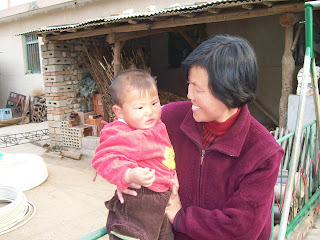
I’ve returned from my trip to rural Hebei Province, where I was primarily visiting a project that establishes small groups to help prevent women’s suicides—rural Chinese women have the highest rate of suicide of any group in the world. I think the highlight was meeting this woman, Li Guimin, who was simultaneously tragic and inspiring, which sums up a lot of lives here, really. The Chinese have a saying, to chi ku, which means to “eat bitterness.” The “bitter” here has much the same meaning as when it is used in American slang (as in a college student saying “I got a C- on my midterm” and his friend replying “Bitter!”) but without the sarcasm. Many people here say that the Chinese are good at chi ku, and there is probably some truth to this. Li Guimin is a 49 year-old woman who is now raising her year-and-a-half old grandson because his mother died mysteriously in her sleep one night and his father, Li Guimin’s son, is working out of the village as a migrant worker, one of millions here. At the same time, however, Li Guimin is a smart and savvy woman who is the head of her village’s suicide prevention groups. There is another saying in Chinese, “nanzhuwai, nuzhunei” which basically means “Men are responsible for outside affairs and women are responsible for inside affairs.” Li noted that now “nuzhuwai” but that “nanbuzhunei.” In other words, women are now also responsible for outside affairs, but men have not taken their share of the “inside” responsibilities. This cracked me up, since this seems to be a problem faced by feminism around the world. (I refer you to my favorite piece of feminist writing, from around 1970, titled “The Politics of Housework.”)
Here is Li and her grandson:
I also just spent two days at a training to promote women’s political participation at a school run by Rural Women outside of Beijing. “Training” is a mania in the NGO sector here these days—much of the time, so far as I can tell, it consists of people sitting around for three hours at a stretch listening to speeches. They seem to have a patience here for this sort of thing that we lack. One hypothesis I have for this relates to the years of communism here—when you have to stand in long lines just to buy a pair of socks, what does it matter that you might have to sit for hours listening to the leaders rattle on (Fidel Castro is apparently supremely talented at this)? While of course in capitalism, time, along with just about everything else, is money. This hypothesis is belied by the fact, however, that queue-jumping is one of the “four pests” they are seeking to eradicate on the road to the Olympics, and no one here really seems to be content to stand in lines at all.
One purpose of all this training is ostensibly to “raise the quality” of those attending. One reason frequently provided for why China is poor (in the county town where I stayed while in the countryside, a monthly income of about $200 is considered quite good) is that its people, and especially its peasants, and even more so its peasant women, have “low quality (suzhi di). Rural Women, the organization, does critique this line of thinking, and I was asked at the training yesterday to give a bit of a talk about how westerners/Americans view this subject. I basically stated that “low quality” is just an excuse the government uses to justify increasing gaps between the rich and poor here (along with the mass of people living on $200 a month, or less), whereas really some of the problem lies in governmental policy. Another American present, representing one of the training’s sponsors, later told Xie Lihua that I had “balls” to say that in front of a room of Chinese people.
Speaking of increasing gaps between rich and poor: new developments of the “villas” increasingly popular among China’s nouveau riche that I passed on the way to the school included “MacAllen Estates,” “Napa Valley,” “Chateau Lafitte Beijing,” and “Vancouver Forest” (where trees are actually quite sparse).
Here is Li and her grandson:

I also just spent two days at a training to promote women’s political participation at a school run by Rural Women outside of Beijing. “Training” is a mania in the NGO sector here these days—much of the time, so far as I can tell, it consists of people sitting around for three hours at a stretch listening to speeches. They seem to have a patience here for this sort of thing that we lack. One hypothesis I have for this relates to the years of communism here—when you have to stand in long lines just to buy a pair of socks, what does it matter that you might have to sit for hours listening to the leaders rattle on (Fidel Castro is apparently supremely talented at this)? While of course in capitalism, time, along with just about everything else, is money. This hypothesis is belied by the fact, however, that queue-jumping is one of the “four pests” they are seeking to eradicate on the road to the Olympics, and no one here really seems to be content to stand in lines at all.
One purpose of all this training is ostensibly to “raise the quality” of those attending. One reason frequently provided for why China is poor (in the county town where I stayed while in the countryside, a monthly income of about $200 is considered quite good) is that its people, and especially its peasants, and even more so its peasant women, have “low quality (suzhi di). Rural Women, the organization, does critique this line of thinking, and I was asked at the training yesterday to give a bit of a talk about how westerners/Americans view this subject. I basically stated that “low quality” is just an excuse the government uses to justify increasing gaps between the rich and poor here (along with the mass of people living on $200 a month, or less), whereas really some of the problem lies in governmental policy. Another American present, representing one of the training’s sponsors, later told Xie Lihua that I had “balls” to say that in front of a room of Chinese people.
Speaking of increasing gaps between rich and poor: new developments of the “villas” increasingly popular among China’s nouveau riche that I passed on the way to the school included “MacAllen Estates,” “Napa Valley,” “Chateau Lafitte Beijing,” and “Vancouver Forest” (where trees are actually quite sparse).
Saturday, April 14, 2007
fate
I realized today that I have been remiss in this blog’s Chinese lessons, so today you’ll get a few words. Our first word is mingyun which means “fate.” The ming in mingyun is also in geming, which means “revolution.” Geming means, literally, to “dismiss fate.” Isn’t that nifty? Doesn’t that just make you want to run out and sign up for a Chinese class?
I’ve been thinking about fate today mostly because of the idea of being “ill-fated,” which my training run today definitely was. I had 20 miles on the schedule for today, made especially difficult because I just did my 18 miler 9 days ago and I usually like to have two weeks between really long runs. I decided to go out to the Yuyuantan Park and try to run 7 laps. The weather today in Beijing is sunny, in the 60s, and somewhat windy. Not shachenbao level windy, but windy. Shachenbao is another new word—it refers to the rather nasty sandstorms that occasionally afflict Beijing in the springtime (someone told me that they are pretty much like the Dust Bowl was in the Great Depression). Even when there is not a shachenbao going on Beijing is rather on the dusty side and so there was a fair amount of junk blowing around. I made it to Yuyuantan Park only to discover that they are having a “Cherry Blossom Festival.” The Chinese are actually not terrifically fond of the Japanese, but apparently that is not enough to stop them from celebrating cherry blossoms. OK, I thought, I’ll go to the track at the university. That, however, was also not meant to be—it was closed for some university visitation day, though there were loads of people around campus and absolutely nothing happening on the track.
So I headed for the King Gym. On the way there I saw two women involved in a fight—I mean literally punching and kicking each other. Such violence is not an entirely uncommon sight here, and rather puts to rest the latest government slogan that China is constructing a hexie shehui or “harmonious society.”
End result: a total of 15 miles, 5 short of my goal but my psyche could only face so long on the treadmill. In two weeks I'll go for 22 miles, my last really long run of the training program. In a certain way, the runs are a relief--at least it is a respite from speaking Chinese. Except for today--while in the King Gym one of the employees asked me whether Bob Dylan is really famous in the United States and if people have problems with the fact that he uses/used drugs (try saying "artistic temperament" in Chinese while also running on a treadmill). Then another employee wanted me to hold down the shop while she went upstairs to buy some candy (appropriate lunch fare for a gym employee, really).
I’ve been thinking about fate today mostly because of the idea of being “ill-fated,” which my training run today definitely was. I had 20 miles on the schedule for today, made especially difficult because I just did my 18 miler 9 days ago and I usually like to have two weeks between really long runs. I decided to go out to the Yuyuantan Park and try to run 7 laps. The weather today in Beijing is sunny, in the 60s, and somewhat windy. Not shachenbao level windy, but windy. Shachenbao is another new word—it refers to the rather nasty sandstorms that occasionally afflict Beijing in the springtime (someone told me that they are pretty much like the Dust Bowl was in the Great Depression). Even when there is not a shachenbao going on Beijing is rather on the dusty side and so there was a fair amount of junk blowing around. I made it to Yuyuantan Park only to discover that they are having a “Cherry Blossom Festival.” The Chinese are actually not terrifically fond of the Japanese, but apparently that is not enough to stop them from celebrating cherry blossoms. OK, I thought, I’ll go to the track at the university. That, however, was also not meant to be—it was closed for some university visitation day, though there were loads of people around campus and absolutely nothing happening on the track.
So I headed for the King Gym. On the way there I saw two women involved in a fight—I mean literally punching and kicking each other. Such violence is not an entirely uncommon sight here, and rather puts to rest the latest government slogan that China is constructing a hexie shehui or “harmonious society.”
End result: a total of 15 miles, 5 short of my goal but my psyche could only face so long on the treadmill. In two weeks I'll go for 22 miles, my last really long run of the training program. In a certain way, the runs are a relief--at least it is a respite from speaking Chinese. Except for today--while in the King Gym one of the employees asked me whether Bob Dylan is really famous in the United States and if people have problems with the fact that he uses/used drugs (try saying "artistic temperament" in Chinese while also running on a treadmill). Then another employee wanted me to hold down the shop while she went upstairs to buy some candy (appropriate lunch fare for a gym employee, really).
Thursday, April 12, 2007
steps
It is only about five weeks until my race, a fact that fills me with some trepidation! I have been training steadily at times and less so at others. Just to give you an idea of what I am preparing for, here is a picture of the Great Wall:

And here is a picture from last year’s race:
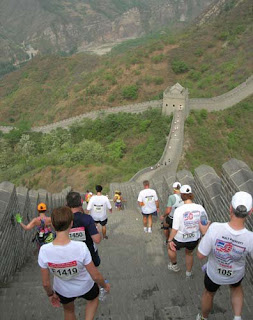
Apparently it is just an urban legend that the Great Wall is the only man-made structure that can be seen from the moon by the naked eye. Nonetheless, it is a rather imposing and impressive structure. The race begins with a 5 ½ mile stretch on the Great Wall itself followed by about 15 miles on roads, and then another 5 ½ miles on the Great Wall. Each Great Wall section features some 3700 steps (both up and down) that are uneven and probably somewhat treacherous (hence the various disclaimers on all the marathon paperwork noting that participants better have their own health insurance and that the race does not cover transport to local hospitals).
Luckily I live on the 11th floor of the building where I’m staying so I’ve been climbing steps, though lately I’ve gotten rather lazy and use the elevator a bit more than when I first arrived here. There are a total of 14 floors in the building, numbered 1-12 (as you’d expect) and then, interestingly, 15 and 16. Of course, 13 is unlucky in the west, and 14 is not terribly lucky here (the word for “four” sounds like the word for “death” in Chinese so, among other things, no one wants mobile phone numbers with 4 in them—even I avoided it when I purchased my number). But there is a 4th floor in the building, just no 14. Sometimes there are strange counting patterns here—for instance, the Beijing subway currently has three lines, numbers 1 and 2 (again, as you’d expect) and number 13 (not so expected).
I’ve started doing step workouts once a week—one time up from bottom to top is 304 steps. Yesterday I did 8 repeats for a total of over 4800 steps (I’m counting the ups and the downs)—it took about 45 minutes. Perhaps this won’t help entirely with the marathon, but it can’t hurt. My plan is to work up to 10 in two weeks (next week I’ll be in the countryside, which will no doubt provide fodder for new running adventures) and then the following week to do 5 repeats, go outside and run a few miles, and then return to do 5 more. Let’s call that a “micro” simulation of the Great Wall Marathon itself.

And here is a picture from last year’s race:

Apparently it is just an urban legend that the Great Wall is the only man-made structure that can be seen from the moon by the naked eye. Nonetheless, it is a rather imposing and impressive structure. The race begins with a 5 ½ mile stretch on the Great Wall itself followed by about 15 miles on roads, and then another 5 ½ miles on the Great Wall. Each Great Wall section features some 3700 steps (both up and down) that are uneven and probably somewhat treacherous (hence the various disclaimers on all the marathon paperwork noting that participants better have their own health insurance and that the race does not cover transport to local hospitals).
Luckily I live on the 11th floor of the building where I’m staying so I’ve been climbing steps, though lately I’ve gotten rather lazy and use the elevator a bit more than when I first arrived here. There are a total of 14 floors in the building, numbered 1-12 (as you’d expect) and then, interestingly, 15 and 16. Of course, 13 is unlucky in the west, and 14 is not terribly lucky here (the word for “four” sounds like the word for “death” in Chinese so, among other things, no one wants mobile phone numbers with 4 in them—even I avoided it when I purchased my number). But there is a 4th floor in the building, just no 14. Sometimes there are strange counting patterns here—for instance, the Beijing subway currently has three lines, numbers 1 and 2 (again, as you’d expect) and number 13 (not so expected).
I’ve started doing step workouts once a week—one time up from bottom to top is 304 steps. Yesterday I did 8 repeats for a total of over 4800 steps (I’m counting the ups and the downs)—it took about 45 minutes. Perhaps this won’t help entirely with the marathon, but it can’t hurt. My plan is to work up to 10 in two weeks (next week I’ll be in the countryside, which will no doubt provide fodder for new running adventures) and then the following week to do 5 repeats, go outside and run a few miles, and then return to do 5 more. Let’s call that a “micro” simulation of the Great Wall Marathon itself.
Thursday, April 5, 2007
horses and jaguars
I ran 18 miles today. It was supposed to be over the last weekend, but I have the third cold of my stay here. Yes, I’d guess that some of you are thinking “how can she run a marathon when she can’t even avoid the Specter of the Common Cold?” Well, that is difficult here. I’d guess that one reason I’ve been getting colds is related to the newly-announced “four pests” that the government is going to try to eradicate before China makes its big global debut in next summer’s Olympics. The four pests are queue-jumping (ha!—good luck with that one), cursing (ditto), smoking (ditto again), and spitting (more dittos). Apparently there have been official “stand in line rather than push in front of others” days, as well as a “smile” campaign and courses to teach shop clerks and taxi drivers how to be more polite. Anyway, the constant spitting makes for a vicious circle, people spit because they have colds, then this just gives other people colds, etc., etc., ad nauseum (or perhaps that should be ad sputum?).
Chinese friends have been plying me with traditional Chinese medicine and I’ve desperately tried it. The short verdict: tastes not so good but it seems to help. Feeling somewhat better today, I decided to seek more adventure, as well as to give myself less of an escape route, by running out toward the suburbs and back along a canal that starts about 1 ½ miles from where I’m staying. On the map it looked promisingly continuous, and I had fond fantasies of getting to some pristine areas as I moved out of the city. Why do I never learn that what looks blank on a map is of course never actually blank in reality, especially in China? Jim and I once departed Beijing and traveled 48 hours by train (it was supposed to be 36, but met delays along the way), 12 hours by long-distance bus, and then a few hours on horseback till we found anything resembling a pristine landscape in China.
Nonetheless, the run was an adventure. The canal was somewhat fetid, to put it politely, when it had water in it, and actually much of it was dry and being worked on for some purpose. I did actually get out of the city, but not before passing an area populated mostly by garbage dumps and military facilities. When I did get to a more pristine area, I was suddenly worried about the isolation, although there were always a few people around, mostly on bicycles. I had brought some money in my pocket in case I desperately needed to bail and get a taxi home. I’m sure this sounds completely contradictory—searching for pristine landscapes and still expecting to find taxis once there, but I actually did see a few taxis along the way.
There were lots of interesting sights. My favorite was actually two, but within 30 seconds of each other, so it counts as one. First was the rather straggly horse and cart that passed me on the other side of the canal. I briefly tried to keep up with the horse, challenging myself to run faster. The horse won, but not by much.
Second was a new-looking Jaguar with Sichuan license plates. This right after the horse and cart pretty much sums up how bizarre things are here these days. Coming from Sichuan by car (which is actually where Jim and I went on the train, bus, and horse in search of pristineness) would just a few years previously have been unimaginable. It would have taken forever and a day, but now they are building new highways at an amazing pace, and road trips are becoming more common here. You haven’t lived till you’ve experienced a Chinese rest stop, believe me.
I also saw a married couple riding matching three-wheeled bicycles with carts on the back with packages of Styrofoam piled 15 feet high. I said hello and they smiled and said hello back, and the man said “this isn’t a very good place to run.” To which I replied, “there isn’t anywhere good to run!” A couple guys drove by in a car and stopped ahead of me. I ran by them and then they caught up to me again with an open window, and one of them asked “Can I help you?” (in English, no less). It was kind of cute, but also worrying since at that point I’d only run 7 miles and thought I looked strong. Perhaps they just thought I’d taken a wrong turn, which was a look I received a lot. Kind of like I was out running along the Central Park Reservoir or someplace where lots of runners actually go and somehow was magically transported to Beijing, where I not only saw no other runners, but not even any other foreigners.
I passed a few small parks with the usual complement of people ballroom dancing and singing in groups, probably Cultural Revolution songs. That seems to be the vogue these days among a certain set of middle-aged folks—going hiking or to the park and singing Cultural Revolution songs along the way. I’m not sure if it is done ironically (I doubt it) or nostalgically (I can’t imagine being nostalgic for the Cultural Revolution—it would be like being nostalgic for the Great Depression, or the Civil War). Perhaps it is just because these are the songs that reside in the collective memory of this generation?
Chinese friends have been plying me with traditional Chinese medicine and I’ve desperately tried it. The short verdict: tastes not so good but it seems to help. Feeling somewhat better today, I decided to seek more adventure, as well as to give myself less of an escape route, by running out toward the suburbs and back along a canal that starts about 1 ½ miles from where I’m staying. On the map it looked promisingly continuous, and I had fond fantasies of getting to some pristine areas as I moved out of the city. Why do I never learn that what looks blank on a map is of course never actually blank in reality, especially in China? Jim and I once departed Beijing and traveled 48 hours by train (it was supposed to be 36, but met delays along the way), 12 hours by long-distance bus, and then a few hours on horseback till we found anything resembling a pristine landscape in China.
Nonetheless, the run was an adventure. The canal was somewhat fetid, to put it politely, when it had water in it, and actually much of it was dry and being worked on for some purpose. I did actually get out of the city, but not before passing an area populated mostly by garbage dumps and military facilities. When I did get to a more pristine area, I was suddenly worried about the isolation, although there were always a few people around, mostly on bicycles. I had brought some money in my pocket in case I desperately needed to bail and get a taxi home. I’m sure this sounds completely contradictory—searching for pristine landscapes and still expecting to find taxis once there, but I actually did see a few taxis along the way.
There were lots of interesting sights. My favorite was actually two, but within 30 seconds of each other, so it counts as one. First was the rather straggly horse and cart that passed me on the other side of the canal. I briefly tried to keep up with the horse, challenging myself to run faster. The horse won, but not by much.
Second was a new-looking Jaguar with Sichuan license plates. This right after the horse and cart pretty much sums up how bizarre things are here these days. Coming from Sichuan by car (which is actually where Jim and I went on the train, bus, and horse in search of pristineness) would just a few years previously have been unimaginable. It would have taken forever and a day, but now they are building new highways at an amazing pace, and road trips are becoming more common here. You haven’t lived till you’ve experienced a Chinese rest stop, believe me.
I also saw a married couple riding matching three-wheeled bicycles with carts on the back with packages of Styrofoam piled 15 feet high. I said hello and they smiled and said hello back, and the man said “this isn’t a very good place to run.” To which I replied, “there isn’t anywhere good to run!” A couple guys drove by in a car and stopped ahead of me. I ran by them and then they caught up to me again with an open window, and one of them asked “Can I help you?” (in English, no less). It was kind of cute, but also worrying since at that point I’d only run 7 miles and thought I looked strong. Perhaps they just thought I’d taken a wrong turn, which was a look I received a lot. Kind of like I was out running along the Central Park Reservoir or someplace where lots of runners actually go and somehow was magically transported to Beijing, where I not only saw no other runners, but not even any other foreigners.
I passed a few small parks with the usual complement of people ballroom dancing and singing in groups, probably Cultural Revolution songs. That seems to be the vogue these days among a certain set of middle-aged folks—going hiking or to the park and singing Cultural Revolution songs along the way. I’m not sure if it is done ironically (I doubt it) or nostalgically (I can’t imagine being nostalgic for the Cultural Revolution—it would be like being nostalgic for the Great Depression, or the Civil War). Perhaps it is just because these are the songs that reside in the collective memory of this generation?
Monday, April 2, 2007
concept vs. execution
So, as I noted in my last entry, it seems that one thing that is common here (though probably not just here) is the inability to follow through and bring to implementation or completion certain ideas or concepts. Often these are quite good ideas—at other times they may be horrible ideas, or only good for some people.
One example of a good idea is the yoga class I attended two weeks ago in the King Gym. What can be wrong with providing stressed out students with the opportunity to stretch, perhaps get a little meditative breathing in, etc.? Well, the problem here is that the King Gym is an exceptionally noisy place, so yoga, which is supposed to be somewhat relaxing and tranquil, became an activity where you strained to listen to the absurdly flexible teacher give instructions (in Chinese, of course) over her portable microphone, while next door the treadmills were going and in the room behind people were playing ping-pong. My favorite part was the end, Savasana or corpse pose, where the teacher turned out the lights and put on this tape of this person saying “relax” over and over again (in Chinese: fangsong) as if somehow just saying it could create the proper atmosphere.
Unfortunately, I fear that the Beijing Olympics will be another example of the “good concept-bad execution” paradigm. I am certain that they will be wonderful in many ways, and I think they are generally good for the city (building new subway lines, supposedly making the city “green” though there is little evidence of that as yet, etc.) There is great pride here in China hosting the Olympics, and I am happy that China was awarded this opportunity. Of course, it is hard not to be a bit concerned by some of the slogans you see around town, notably the one that says “Xin Beijing, Xin Aoyun” which literally translated means “New Beijing, New Olympics.” However, the provided translation says “New Beijing, Great Olympics,” which makes me wonder if there is some sort of insidious plan afloat for the “New Olympics” that they would rather laowais not contemplate. I also actually feel somewhat sorry for the athletes who prepare their whole lives for their one moment to be in the Olympics and will end up here. The claim is that the air will be cleaned up in time, but so far I see little progress on that. Beijing is also appallingly hot in the summer and I can’t imagine it will be a very good setting for breaking of sports records. It also has a looming shortage of water, which is of course relevant for the Olympics because, as my friend Xie Lihua said in discussing the issue, “athletes need to shower a lot.”
Also relating to water and this topic of discussion, my new room here, where I moved when Jim came, has a persistent shower problem. In many places in China (and elsewhere around Asia and in the world) there is no separate tub or shower structure—you just shower and there is a drain in the bathroom floor where the water goes, and the floor just gets kind of wet. Unless, of course, you are in my bathroom here, where the drain is actually in the highest part of the floor and so all the water flows away from the drain and the bathroom does not just get kind of wet. I bought a mop that I have to use to push the water toward the drain when I’m done. I asked about it at the front desk and they apologized, said many rooms were like this, and that it is an “engineering problem.” Well, this building is only about three years old. China is one big construction site, and one consequence of this is that often new buildings are total crap, to put it bluntly.
I actually wonder if this is reflective of modernization, or modernity, as a whole. Excellent in concept, often flawed in execution. Global warming, anyone?
One example of a good idea is the yoga class I attended two weeks ago in the King Gym. What can be wrong with providing stressed out students with the opportunity to stretch, perhaps get a little meditative breathing in, etc.? Well, the problem here is that the King Gym is an exceptionally noisy place, so yoga, which is supposed to be somewhat relaxing and tranquil, became an activity where you strained to listen to the absurdly flexible teacher give instructions (in Chinese, of course) over her portable microphone, while next door the treadmills were going and in the room behind people were playing ping-pong. My favorite part was the end, Savasana or corpse pose, where the teacher turned out the lights and put on this tape of this person saying “relax” over and over again (in Chinese: fangsong) as if somehow just saying it could create the proper atmosphere.
Unfortunately, I fear that the Beijing Olympics will be another example of the “good concept-bad execution” paradigm. I am certain that they will be wonderful in many ways, and I think they are generally good for the city (building new subway lines, supposedly making the city “green” though there is little evidence of that as yet, etc.) There is great pride here in China hosting the Olympics, and I am happy that China was awarded this opportunity. Of course, it is hard not to be a bit concerned by some of the slogans you see around town, notably the one that says “Xin Beijing, Xin Aoyun” which literally translated means “New Beijing, New Olympics.” However, the provided translation says “New Beijing, Great Olympics,” which makes me wonder if there is some sort of insidious plan afloat for the “New Olympics” that they would rather laowais not contemplate. I also actually feel somewhat sorry for the athletes who prepare their whole lives for their one moment to be in the Olympics and will end up here. The claim is that the air will be cleaned up in time, but so far I see little progress on that. Beijing is also appallingly hot in the summer and I can’t imagine it will be a very good setting for breaking of sports records. It also has a looming shortage of water, which is of course relevant for the Olympics because, as my friend Xie Lihua said in discussing the issue, “athletes need to shower a lot.”
Also relating to water and this topic of discussion, my new room here, where I moved when Jim came, has a persistent shower problem. In many places in China (and elsewhere around Asia and in the world) there is no separate tub or shower structure—you just shower and there is a drain in the bathroom floor where the water goes, and the floor just gets kind of wet. Unless, of course, you are in my bathroom here, where the drain is actually in the highest part of the floor and so all the water flows away from the drain and the bathroom does not just get kind of wet. I bought a mop that I have to use to push the water toward the drain when I’m done. I asked about it at the front desk and they apologized, said many rooms were like this, and that it is an “engineering problem.” Well, this building is only about three years old. China is one big construction site, and one consequence of this is that often new buildings are total crap, to put it bluntly.
I actually wonder if this is reflective of modernization, or modernity, as a whole. Excellent in concept, often flawed in execution. Global warming, anyone?
Monday, March 26, 2007
30,000
On Friday Jim and visited the Panjiayuan market, where all variety of antiques and “antiques” can be found. We were accosted for a long period of time by a gentleman from Henan Province who claimed to be an English teacher who sells antiques in his spare time and really wanted to practice his English on us. We also found a Buddhist artifact that we really liked and wanted a closer look—I asked how old it was and they paused, and then said, “Tang Dynasty.” Well, that would make it anywhere from 1100 to 1400 years old—Jim started laughing out loud. I then asked what they wanted for it and was told “san wan.” I had to ask again and was told, for a second time, “san wan.” Well, that is 30,000 yuan, about $4000! We walked away very fast, with them hot on our tail. If I’d wanted to bother, I would have said that “Starting at 30,000 yuan for an item of dubious origins and authenticity didn’t really give us much negotiating room, did it?!” Usually when bargaining for a price, I feel comfortable offering about one-third of the original asking price, or at the very least one-fourth, so we really had nowhere to go with this one!
On a mostly unrelated note, I have been unable to access my own blog from here (Chinese word of the day: blog=bo’ke). This has led me to go to the Blogger help page (which I can access) to find, almost immediately, a query from someone with the heading “Cannot access my blog in China.” Apparently the Chinese government’s internet censors (sometimes referred to as the Great Firewall of China) periodically block Blogspot. After all, people might use their blogs to write inflammatory things, like noting that the National People’s Congress is really just a rubber stamp legislature or that Beijing opera sounds like cats screeching, and that these facts might actually be shocking news to people in China, things that they had never heard before or would be incapable of thinking of themselves. Chairman Mao himself wrote that “It is on a blank page that the most beautiful poems are written,” as a way of justifying his various schemes for social engineering.
The rumor in the foreign media and among human rights groups is that the Chinese government employs 30,000 censors to monitor internet content and block sites. Interestingly, they don’t usually block The New York Times or some other western news sites—they are more concerned about sites in Chinese, for obvious reasons. Nonetheless, there are ways of getting around the censorship, notably through what are called proxy servers. Within minutes of beginning my search I was directed to this sort of server, the home page of which reads at the top “Is your blog blocked in India, Pakistan, Iran, or China?” I’m not sure why India wants to be in such illustrious company, given its status as the only real democracy in this list (see, that’s the sort of statement that gets blogs censored here), but apparently all of these countries block Blogspot.
My guess is that, following the conclusion of the two-week-long lianghui, the government feels that foreign media scrutiny will be lessened and so they can revert to a higher level of censorship. This actually reminds me of a common phenomenon here—the often wide gap between concept and execution, in which what seem to be good ideas (to someone, in this case the regime) often fall short in their implementation. In the case of the heightened censorship, perhaps the regime feels that no one will notice--I often observe that they might benefit from having a really good p.r. firm on retainer, who would tell them that the benefits of censoring sites like Blogspot might be outweighed by the costs, like the fact that people are actually going to notice that this is occurring. The "good idea-bad execution" paradigm is a topic about which I have so much to say that it will have to wait till the next entry.
On a mostly unrelated note, I have been unable to access my own blog from here (Chinese word of the day: blog=bo’ke). This has led me to go to the Blogger help page (which I can access) to find, almost immediately, a query from someone with the heading “Cannot access my blog in China.” Apparently the Chinese government’s internet censors (sometimes referred to as the Great Firewall of China) periodically block Blogspot. After all, people might use their blogs to write inflammatory things, like noting that the National People’s Congress is really just a rubber stamp legislature or that Beijing opera sounds like cats screeching, and that these facts might actually be shocking news to people in China, things that they had never heard before or would be incapable of thinking of themselves. Chairman Mao himself wrote that “It is on a blank page that the most beautiful poems are written,” as a way of justifying his various schemes for social engineering.
The rumor in the foreign media and among human rights groups is that the Chinese government employs 30,000 censors to monitor internet content and block sites. Interestingly, they don’t usually block The New York Times or some other western news sites—they are more concerned about sites in Chinese, for obvious reasons. Nonetheless, there are ways of getting around the censorship, notably through what are called proxy servers. Within minutes of beginning my search I was directed to this sort of server, the home page of which reads at the top “Is your blog blocked in India, Pakistan, Iran, or China?” I’m not sure why India wants to be in such illustrious company, given its status as the only real democracy in this list (see, that’s the sort of statement that gets blogs censored here), but apparently all of these countries block Blogspot.
My guess is that, following the conclusion of the two-week-long lianghui, the government feels that foreign media scrutiny will be lessened and so they can revert to a higher level of censorship. This actually reminds me of a common phenomenon here—the often wide gap between concept and execution, in which what seem to be good ideas (to someone, in this case the regime) often fall short in their implementation. In the case of the heightened censorship, perhaps the regime feels that no one will notice--I often observe that they might benefit from having a really good p.r. firm on retainer, who would tell them that the benefits of censoring sites like Blogspot might be outweighed by the costs, like the fact that people are actually going to notice that this is occurring. The "good idea-bad execution" paradigm is a topic about which I have so much to say that it will have to wait till the next entry.
Monday, March 19, 2007
Running in the Key of G
Jim is here now—a fact that has made my life much happier. Things are just better when shared with the one you love! We have been hanging out, eating lots of good food (I have to make the admission that probably our favorite restaurant so far has been the Thai one called Purple Haze), doing some running and yoga. On Saturday I ran 16 miles, part of which were with Jim but then we went opposing ways in Yuyuantan Park because he is still recovering from foot surgery. The park is evolving as springtime comes; the lake has thawed and people are beginning to take little rental boats on it. It was rather crowded and we had to do quite a bit of dodging of people—besides one other man, we were the only runners among the throngs.
I spent much of my run thinking about an article from the New York Times that I had read online that day, about the conclusion of the lianghui here in Beijing—lianghui means “two meetings,” and this refers to the annual two-week-long meeting of the National People’s Congress, China’s rubber stamp legislature, and the National People’s Political Consultative Congress. Joseph Kahn, the current China correspondent for the Times, usually writes worthwhile stuff, and this piece also was interesting and valid on the face of it. However, I also found it frustrating and it made me contemplate the hazards of cultural comparisons (more on that in a moment). Here is the article:
Chinese Leader Strikes Defensive Tone
China does have alarmingly increasing amounts of foreign reserves, air pollution (probably the source of my apparently never-ending cold), and military spending. Yet I still felt annoyed by this article. The statement that frustrated me most was “China has become the largest consumer of energy after the United States and by some estimates the largest emitter of gases that contribute to global warming after the United States as well.” While true in absolute terms, what might be wrong with that statement? In other words, why is it not just a statement of journalistic fact? I will leave it to readers to draw their own conclusions on that matter.
On my run while pondering this article I also listened to my iPod—I decided that I couldn’t feel inspired by the soundtrack that is piped over the speakers in the park, which primarily consists of Kenny G. Kenny G is probably more appropriate as music for insomniacs than music for runners, if it is appropriate for anyone at all. They completely love Kenny G here—for instance, his is the only music of choice in the Korean/Japanese restaurant downstairs from where I live. Which actually made me further consider the topic of cultural comparison, and on what basis we make such comparisons. For instance, I have had more than one Chinese person say to me, “I don’t like American food—McDonald’s is really just not very good.” I’ve occasionally pointed out that it probably isn’t accurate to equate American food with McDonald’s (just as it isn’t a good idea to equate Kenny G with American music), but this is a difficult concept to get across (besides, I’m coming up short on what really is American food and not something derived from our history of being immigrants—about the best I can come up with is chocolate chip cookies, which are a very fine addition to global cuisine indeed).
Equivalent American comparisons with China might include the misconception that Chinese food primarily consists of sticky sweet goo like sweet and sour pork (actually an American invention) and fortune cookies (also an American invention) and that Chinese music primarily extends to Beijing opera, which can be quite nice at times but also incorporates what to our ears sounds like cats screeching and toddlers banging on pot lids.
I spent much of my run thinking about an article from the New York Times that I had read online that day, about the conclusion of the lianghui here in Beijing—lianghui means “two meetings,” and this refers to the annual two-week-long meeting of the National People’s Congress, China’s rubber stamp legislature, and the National People’s Political Consultative Congress. Joseph Kahn, the current China correspondent for the Times, usually writes worthwhile stuff, and this piece also was interesting and valid on the face of it. However, I also found it frustrating and it made me contemplate the hazards of cultural comparisons (more on that in a moment). Here is the article:
Chinese Leader Strikes Defensive Tone
China does have alarmingly increasing amounts of foreign reserves, air pollution (probably the source of my apparently never-ending cold), and military spending. Yet I still felt annoyed by this article. The statement that frustrated me most was “China has become the largest consumer of energy after the United States and by some estimates the largest emitter of gases that contribute to global warming after the United States as well.” While true in absolute terms, what might be wrong with that statement? In other words, why is it not just a statement of journalistic fact? I will leave it to readers to draw their own conclusions on that matter.
On my run while pondering this article I also listened to my iPod—I decided that I couldn’t feel inspired by the soundtrack that is piped over the speakers in the park, which primarily consists of Kenny G. Kenny G is probably more appropriate as music for insomniacs than music for runners, if it is appropriate for anyone at all. They completely love Kenny G here—for instance, his is the only music of choice in the Korean/Japanese restaurant downstairs from where I live. Which actually made me further consider the topic of cultural comparison, and on what basis we make such comparisons. For instance, I have had more than one Chinese person say to me, “I don’t like American food—McDonald’s is really just not very good.” I’ve occasionally pointed out that it probably isn’t accurate to equate American food with McDonald’s (just as it isn’t a good idea to equate Kenny G with American music), but this is a difficult concept to get across (besides, I’m coming up short on what really is American food and not something derived from our history of being immigrants—about the best I can come up with is chocolate chip cookies, which are a very fine addition to global cuisine indeed).
Equivalent American comparisons with China might include the misconception that Chinese food primarily consists of sticky sweet goo like sweet and sour pork (actually an American invention) and fortune cookies (also an American invention) and that Chinese music primarily extends to Beijing opera, which can be quite nice at times but also incorporates what to our ears sounds like cats screeching and toddlers banging on pot lids.
Friday, March 9, 2007
Amish Cooking
I actually saw another runner on Tuesday, in Xidan, one of the busiest areas of Beijing. This is a part of the city that has been thoroughly transformed by Beijing’s rapid development—it lies just a little bit west of Tiananmen Square, right on Chang’an Avenue (the Avenue of Eternal Peace). Xidan is now full of department stores and a hip underground shopping mall populated by teenagers wearing unrecognizable yet apparently very fashionable things. It also features at least two Starbucks within 100 yards of each other, a fact that both pleases and horrifies me (if you ask nicely, I can give you my classtime-perfected riff on how Starbucks epitomizes both the joys and horrors of globalization all in one venti nonfat double shot caramel macchiato, not that this is a particularly original observation).
It was a very nice, clear day, and so seeing another runner was inspiring and somewhat shocking. Of course, this runner was a laowai, and this enabled me to perhaps see myself through the eyes of Chinese observers as I am running on the streets here (something that has occurred rather seldom so far, due to the proximity and anonymity provided by the King Gym). This male laowai runner was wearing knee-length running tights, with an emphasis on the tight, if you know what I mean. My first thought, before I really processed the whole scene, was “What kind of nut goes running in Xidan in midday, in that sort of get-up?” And then of course I reflected on my own thinking, and realized that I probably look as absurd to Chinese observers when I am out running. I’d like to think that my choice of running apparel is never quite so outré, but then again, I’ve seen Chinese running in their street clothes (not the ones running for the bus, but actually out exercising in the parks) and even their street shoes, so perhaps any of our Western, consumerist, “I need special gear for whatever activity I’m doing” attitudes seem strange and perhaps somewhat langfei here (our word of the day—it means “wasteful”).
Speaking of joys and horrors of globalization, one of my favorite sights in all of Japan, land of Mount Fuji (briefly glimpsed from a train window), wonderful gardens (I think I drove Kelly nuts in search of Japanese gardens because of my fascination with them and my actual desire and emerging scheme to put one in our backyard), Zen temples, and hypermodern urban landscapes, was actually this one:
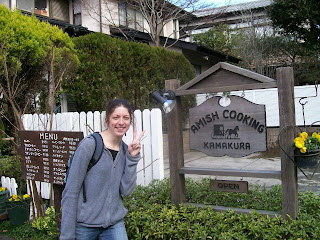
Kelly in Kamakura
We stopped to take some pictures because I was just so amused by it and the owner came out. He told Kelly that he’s been to Amish country in the U.S. before and really appreciated the spirit of the Amish. He said he uses real Amish recipes, but we opted not to stop to try them.
Here is a more zhenzheng Japanese image. Here we are, being very Japanese, simultaneously at a Shinto Shrine and admiring flowers (possibly cherry blossoms, but I don’t think so). In Japan, they love the cherry blossoms. In fact, they have “cherry blossom reports” on the TV news, cherry blossom viewing parties, and you are even supposed to accessorize your home with a cherry blossom motif, but only while they are in season. They even come out with cherry flavor Kit-Kat bars, but again, only in season!

It was a very nice, clear day, and so seeing another runner was inspiring and somewhat shocking. Of course, this runner was a laowai, and this enabled me to perhaps see myself through the eyes of Chinese observers as I am running on the streets here (something that has occurred rather seldom so far, due to the proximity and anonymity provided by the King Gym). This male laowai runner was wearing knee-length running tights, with an emphasis on the tight, if you know what I mean. My first thought, before I really processed the whole scene, was “What kind of nut goes running in Xidan in midday, in that sort of get-up?” And then of course I reflected on my own thinking, and realized that I probably look as absurd to Chinese observers when I am out running. I’d like to think that my choice of running apparel is never quite so outré, but then again, I’ve seen Chinese running in their street clothes (not the ones running for the bus, but actually out exercising in the parks) and even their street shoes, so perhaps any of our Western, consumerist, “I need special gear for whatever activity I’m doing” attitudes seem strange and perhaps somewhat langfei here (our word of the day—it means “wasteful”).
Speaking of joys and horrors of globalization, one of my favorite sights in all of Japan, land of Mount Fuji (briefly glimpsed from a train window), wonderful gardens (I think I drove Kelly nuts in search of Japanese gardens because of my fascination with them and my actual desire and emerging scheme to put one in our backyard), Zen temples, and hypermodern urban landscapes, was actually this one:

Kelly in Kamakura
We stopped to take some pictures because I was just so amused by it and the owner came out. He told Kelly that he’s been to Amish country in the U.S. before and really appreciated the spirit of the Amish. He said he uses real Amish recipes, but we opted not to stop to try them.
Here is a more zhenzheng Japanese image. Here we are, being very Japanese, simultaneously at a Shinto Shrine and admiring flowers (possibly cherry blossoms, but I don’t think so). In Japan, they love the cherry blossoms. In fact, they have “cherry blossom reports” on the TV news, cherry blossom viewing parties, and you are even supposed to accessorize your home with a cherry blossom motif, but only while they are in season. They even come out with cherry flavor Kit-Kat bars, but again, only in season!

Saturday, March 3, 2007
Moshi moshi!
I am now back from Japan, which was a great experience. Some running content first: on the day after I arrived we were eating our Japanese breakfast (sitting on the floor on tatami mats, eating things like fermented soybeans and fish and lots of seaweedy stuff) and on TV was the Tokyo Marathon. Had I planned better, that might have been a more reasonable choice since it does not involve 7000 steps and the Japanese actually understand running! At least in some places they do—in Tochio, the small town where my student Kelly teaches English, she says that she and this one guy are the only runners in town. Other places, however, we saw runners galore, which actually made Kelly wonder what was going on. In Kamakura, an ancient capital of Japan, we saw tons of them, including some in groups. That is probably explainable by the fact that Kamakura is not only an ancient capital with lots of Zen temples, but also an upper-middle class (at least it seemed so) bedroom community of Tokyo. Wherever you find yuppies, you can also probably find runners.
Despite my frequent admonitions in my teaching and in life in general regarding the hazards of stereotyping, I am now going to engage in some discussion of Japan that does just that. Generalities are inevitable, even if sometimes problematic, but also they can reveal some fundamental truths. I’ll even organize this into numbered and lettered examples, so as to enable you to enjoy some of the fruits of my Political Science-educated analytical mind.
1. Japan is polite. (I guess it would be better to say “Japanese people are polite.”)
a. All over you see people wearing surgical face masks, even though the vast majority of them are not surgeons and probably do not even play surgeons on TV. Unlike in China, where mostly people wear such masks to reduce the effects of the pollution, in Japan people wear them when they are sick, to avoid infecting others.
b. Despite the fact that Japan is a mobile-phone crazed society (some 80 million subscribers in a population of 127 million) they are not supposed to talk on them or even let them ring on the shinkansen (bullet train) or parts of the subway system in Tokyo. And people actually follow these rules—when people’s phones vibrated (remember, no ringing) on the bullet train they would always go to the corridor between cars to have their conversation.
b (1). When they can answer their phone, they say not “konichi-wa,” which is Japanese for “hello,” but rather “moshi moshi”. I find this inherently more polite than in China, where the phone is answered by saying “wei?!” which basically means “Hey?!” This usually comes out kind of surly. However, I think it would be almost impossible to be surly while saying “moshi moshi.”
c. The Japanese language is full of other politenesses. When Kelly and I entered the museum at the atomic bomb site in Nagasaki, Kelly was carrying a soda can. The woman from behind the entrance desk came running up, and said, in English “Is it OK or not for you to carry that can inside?” (or something like that). What she really was saying was “It is not OK for you to carry that can inside” but that would have been too direct, so instead it was a question.
d. Before she returned home, Kelly had to buy gifts, known as omiyage, for all of the teachers in the schools in which she teaches. That is 70 people, folks. This is a common custom—wherever you go, you buy omiyage for your co-workers because you are supposed to feel guilty (or shameful—some scholars say Westerners do guilt and Asians do shame) for being on vacation while they were left behind to toil in your absence. All over the place, for instance in Tokyo Station, you find nicely wrapped boxes with labels saying something like “this box is good for 8 people.”
e. Generally you do not criticize your boss or your coworkers so as not to destroy the wa, or the harmony of your workplace community. However, there is one time that this is permitted, and that is at an enkai. This is when you all go out together, get smashingly drunk, and then are permitted to be honest with your boss.
f. In Japan, they do not even jaywalk. If you are at a light and it is red, you wait for it to turn green, even if there is not another car or pedestrian around. Admittedly this is a rare occurrence, but in Kelly’s small town of Tochio (not to be confused with Tokyo) we were walking home from an evening of ramen, gyoza, and karaoke (I sang, badly, “I Will Survive”—I’m considering going on an “I Will Survive” karaoke tour of the world since I have now sung it in at least two countries) and there was no one else around. Nonetheless, we waited for the green light to cross.
g. People do not litter, even though trash cans are few and far between. Instead, they hold their trash till they return home and can throw it away on their own turf.
2. Japan is safe.
a. See 1f above.
b. On the Tokyo subway, you can see small schoolchildren in the morning and evening (I’m talking ages 6 and up here) on their way to school. Alone. Without parental accompaniment. Try that anywhere in the U.S., much less anywhere with a subway system, and watch the parents promptly arrested for child endangerment.
c. Kelly liked to joke that in Japan the police primarily exist to give directions, a hypothesis that we were able to test a few times and does actually seem to be true.
3. Japan is clean.
a. See 1a above.
b. See 1g above.
c. In private dwellings and in some other spots you are expected to remove your shoes. I was in Japan less than 6 hours before committing my first shoe faux pas, which just involved stepping my shoes on the wrong part of the floor as we were entering the onsen (Japanese bath, where everyone is naked together—single-sex only—a story for another time and place, perhaps).
c (1). Due to the removal of shoes, you often wear slippers around indoors, or at least hopefully socks without holes. In several places, you were expected to change your slippers into the special ones provided for going into the toilet. Sometimes, these are even helpfully labeled “toilet” so you are very clear about when and where to wear them.
c (2). While on the subject of toilets, Japanese toilets often come equipped with all sorts of extra features, accessible by buttons on the side. For instance, on many you raise and lower the seat cover by pushing a button. Some have heated seats (much nicer than in a car, really), and built in bidets, so you have to be careful to push the right button or else you might be getting some unexpected services.
4. Japan is a technophile’s dream. (These are admittedly all incredibly trivial examples.)
a. See 3c(2) above.
b. Everywhere you go you see vending machines selling beverages. Even beer.
c. I had sushi for breakfast one morning at the Tsukiji fish market, which is where most of Japan’s (amazing, by the way) seafood originates. They had a picture menu where you could pick which sushi you wanted. When I entered (a little counter place that could seat maybe a dozen people) I was handed a laser pointer to point to my sushi choice. Very clever.
d. Along with many other toilet options, many public restrooms feature a motion activated flushing sound effect, which helps obscure the noise of what you are doing in there. Apparently this was introduced to save water from people actually flushing to do this. Which of course takes us back to the “Japan is polite” point.
Since this is getting rather long, I will stop here for now…Next entry will feature a few Japan photos and perhaps even some updates on my marathon training!
Despite my frequent admonitions in my teaching and in life in general regarding the hazards of stereotyping, I am now going to engage in some discussion of Japan that does just that. Generalities are inevitable, even if sometimes problematic, but also they can reveal some fundamental truths. I’ll even organize this into numbered and lettered examples, so as to enable you to enjoy some of the fruits of my Political Science-educated analytical mind.
1. Japan is polite. (I guess it would be better to say “Japanese people are polite.”)
a. All over you see people wearing surgical face masks, even though the vast majority of them are not surgeons and probably do not even play surgeons on TV. Unlike in China, where mostly people wear such masks to reduce the effects of the pollution, in Japan people wear them when they are sick, to avoid infecting others.
b. Despite the fact that Japan is a mobile-phone crazed society (some 80 million subscribers in a population of 127 million) they are not supposed to talk on them or even let them ring on the shinkansen (bullet train) or parts of the subway system in Tokyo. And people actually follow these rules—when people’s phones vibrated (remember, no ringing) on the bullet train they would always go to the corridor between cars to have their conversation.
b (1). When they can answer their phone, they say not “konichi-wa,” which is Japanese for “hello,” but rather “moshi moshi”. I find this inherently more polite than in China, where the phone is answered by saying “wei?!” which basically means “Hey?!” This usually comes out kind of surly. However, I think it would be almost impossible to be surly while saying “moshi moshi.”
c. The Japanese language is full of other politenesses. When Kelly and I entered the museum at the atomic bomb site in Nagasaki, Kelly was carrying a soda can. The woman from behind the entrance desk came running up, and said, in English “Is it OK or not for you to carry that can inside?” (or something like that). What she really was saying was “It is not OK for you to carry that can inside” but that would have been too direct, so instead it was a question.
d. Before she returned home, Kelly had to buy gifts, known as omiyage, for all of the teachers in the schools in which she teaches. That is 70 people, folks. This is a common custom—wherever you go, you buy omiyage for your co-workers because you are supposed to feel guilty (or shameful—some scholars say Westerners do guilt and Asians do shame) for being on vacation while they were left behind to toil in your absence. All over the place, for instance in Tokyo Station, you find nicely wrapped boxes with labels saying something like “this box is good for 8 people.”
e. Generally you do not criticize your boss or your coworkers so as not to destroy the wa, or the harmony of your workplace community. However, there is one time that this is permitted, and that is at an enkai. This is when you all go out together, get smashingly drunk, and then are permitted to be honest with your boss.
f. In Japan, they do not even jaywalk. If you are at a light and it is red, you wait for it to turn green, even if there is not another car or pedestrian around. Admittedly this is a rare occurrence, but in Kelly’s small town of Tochio (not to be confused with Tokyo) we were walking home from an evening of ramen, gyoza, and karaoke (I sang, badly, “I Will Survive”—I’m considering going on an “I Will Survive” karaoke tour of the world since I have now sung it in at least two countries) and there was no one else around. Nonetheless, we waited for the green light to cross.
g. People do not litter, even though trash cans are few and far between. Instead, they hold their trash till they return home and can throw it away on their own turf.
2. Japan is safe.
a. See 1f above.
b. On the Tokyo subway, you can see small schoolchildren in the morning and evening (I’m talking ages 6 and up here) on their way to school. Alone. Without parental accompaniment. Try that anywhere in the U.S., much less anywhere with a subway system, and watch the parents promptly arrested for child endangerment.
c. Kelly liked to joke that in Japan the police primarily exist to give directions, a hypothesis that we were able to test a few times and does actually seem to be true.
3. Japan is clean.
a. See 1a above.
b. See 1g above.
c. In private dwellings and in some other spots you are expected to remove your shoes. I was in Japan less than 6 hours before committing my first shoe faux pas, which just involved stepping my shoes on the wrong part of the floor as we were entering the onsen (Japanese bath, where everyone is naked together—single-sex only—a story for another time and place, perhaps).
c (1). Due to the removal of shoes, you often wear slippers around indoors, or at least hopefully socks without holes. In several places, you were expected to change your slippers into the special ones provided for going into the toilet. Sometimes, these are even helpfully labeled “toilet” so you are very clear about when and where to wear them.
c (2). While on the subject of toilets, Japanese toilets often come equipped with all sorts of extra features, accessible by buttons on the side. For instance, on many you raise and lower the seat cover by pushing a button. Some have heated seats (much nicer than in a car, really), and built in bidets, so you have to be careful to push the right button or else you might be getting some unexpected services.
4. Japan is a technophile’s dream. (These are admittedly all incredibly trivial examples.)
a. See 3c(2) above.
b. Everywhere you go you see vending machines selling beverages. Even beer.
c. I had sushi for breakfast one morning at the Tsukiji fish market, which is where most of Japan’s (amazing, by the way) seafood originates. They had a picture menu where you could pick which sushi you wanted. When I entered (a little counter place that could seat maybe a dozen people) I was handed a laser pointer to point to my sushi choice. Very clever.
d. Along with many other toilet options, many public restrooms feature a motion activated flushing sound effect, which helps obscure the noise of what you are doing in there. Apparently this was introduced to save water from people actually flushing to do this. Which of course takes us back to the “Japan is polite” point.
Since this is getting rather long, I will stop here for now…Next entry will feature a few Japan photos and perhaps even some updates on my marathon training!
Subscribe to:
Comments (Atom)